
If you think a modern automobile is just a mechanical structure rolling on wheels, you are missing the profound evolution the automotive industry has undergone over the past two decades. Today’s vehicles are veritable rolling data centers where hundreds of sensors, cameras, and dozens of Electronic Control Units (ECUs) exchange millions of data packets per second. While the total cable length in the mechanical cars of the past was only a few hundred meters, in today’s next-generation hybrid and electric vehicles (EVs), this length can reach up to 3 to 5 kilometers. This massive communication network and energy flow simply cannot be managed by traditional, heavy, and thick cables. If they were, vehicles would become sluggish, fuel consumption would skyrocket, and the risk of failure would be maximized. At Sule Kablo, we respond to these rigorous demands of the automotive industry with our FLRY-Y multi-core power cables and CAN BUS communication systems, offering solutions fully compliant with international automotive standards.
For information and orders, contact us via our contact page or WhatsApp.
What is FLRY-Y Wire? Power and Durability in Multi-Core Automotive Solutions
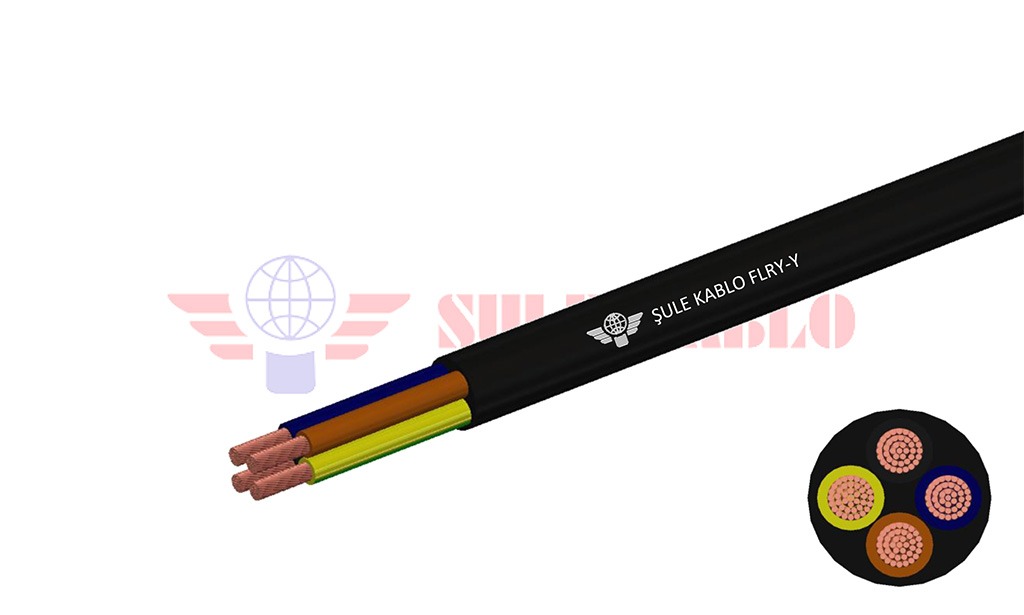
Unlike the single-core FLRY-A and FLRY-B cables we analyzed in our earlier articles, the FLRY-Y cable is a multi-core structure formed by gathering several insulated cores under a single outer jacket (PVC). The letter “Y” here represents the durable PVC outer jacket that protects the cable from external factors. As detailed in our Sule Kablo 2025 product catalog, we have the technological capacity to manufacture these cables with anywhere from 2 to 7 cores, and with cross-sections up to 2.50 mm², depending on the specific needs of the project.
So, where exactly are FLRY-Y cables used in vehicles? The most common application area is the critical connections between the towing vehicle and the trailer. The multi-core structure that goes into 7-pin or 13-pin sockets carries all the power from the vehicle’s rear stop lights and turn signals to the brake warnings and reverse lighting through a single line to the back. Furthermore, FLRY-Y is also preferred in multi-functional sensor groups located at the bottom of the vehicle near the outer chassis, and in complex components like wiper motors. Thanks to its robust outer jacket, it provides extra protection against stones bouncing off the roads, mechanical impacts, corrosive vehicle fluids such as antifreeze, engine oil, or brake fluid, and severe temperature fluctuations ranging from -40°C to +105°C.
(Product Link: Explore Our Sule Kablo FLRY-Y Multi-Core Automotive Cables and Cross-Section Options)
The Nervous System of the Vehicle: CAN BUS (Controller Area Network) Technology
We have solved power transmission with the highly durable FLRY-Y series, but what about the critically important data? The CAN Cable, or more formally the Controller Area Network Bus cable, is the central backbone that allows the independent brains inside the vehicle (engine control unit, ABS module, airbag modules, transmission control, and infotainment system) to communicate with each other instantly and flawlessly. In the past, a separate cable was routed from every sensor to the main unit. Thanks to the CAN system, all modules communicate over a common data bus, reducing the vehicle’s cable weight by hundreds of kilograms.
Let’s illustrate this with a real-life scenario: You are driving at 100 km/h in a vehicle equipped with an Autonomous Emergency Braking (AEB) system. The radar or camera on the front bumper detects a pedestrian suddenly stepping onto the road. This information is transmitted to the Main ECU in a fraction of a millisecond; the ECU evaluates the data from the speed sensors and sends a direct “Brake!” command to the ABS module via the CAN BUS line. Any delay in this vital communication or corruption due to electromagnetic interference (EMI) on the road could result in a disaster.
Why is a “Twisted Pair” Used?
The interior of a vehicle is a very “noisy” environment electrically, largely due to ignition coils and alternators. CAN BUS cables are manufactured in a “Twisted Pair” structure to prevent this external electromagnetic interference (EMI) and radio frequency interference (RFI) from corrupting the data packets. Twisting the cores together at a specific angle ensures that external magnetic fields affect both wires equally, allowing the signal to cancel out this noise using the logic of “differential transmission.”
Whether you are manufacturing a new generation electric vehicle preparing for autonomous driving technologies or managing a fleet of heavy-duty vehicles working in harsh construction site conditions… The FLRY cable harnesses and CAN BUS communication infrastructure you need are secured by Sule Kablo’s 100% pure copper conductor guarantee and international quality standards. Do not risk this delicate communication between your vehicle’s brain and muscles with ordinary cables; choose quality.
For information and orders, contact us via our contact page or WhatsApp.