
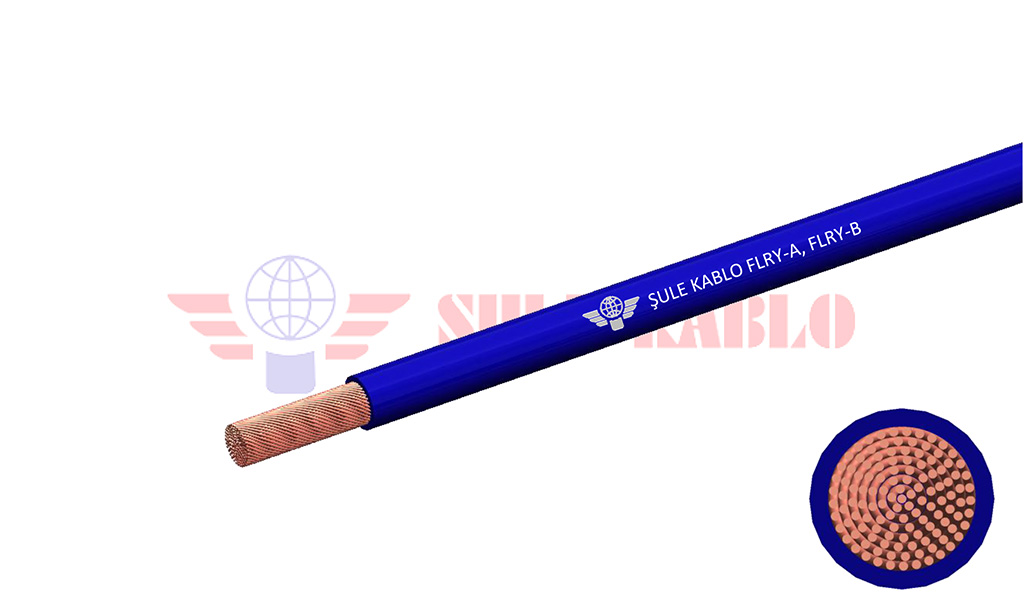
When you lift the hood of a modern automobile, you are not just looking at a mechanical engine, but a complex nervous system spanning kilometers in length. Today’s vehicles contain far more sensors, cameras, and Electronic Control Units (ECUs) than their predecessors. This technological revolution creates a paradox: vehicles need to get lighter, yet the density of wiring increases. This is exactly where FLRY type cables, the unsung heroes of the automotive industry, come into play. As Sule Kablo, we have compiled the technical details and selection criteria of these world-class cables for you.
What is FLRY and Why is it the Standard? “FLRY” refers to low-voltage, PVC-insulated, thin-walled automotive cables produced according to German DIN 72551 standards. The letter “R” stands for “Reduced” wall thickness. This indicates that the insulation is thinner to save space and weight, without compromising electrical insulation performance. This feature allows vehicle wiring harnesses to occupy less volume, contributing significantly to fuel efficiency by reducing total vehicle weight.
(Product Review: [View Our FLRY Automotive Cables])
The Critical Differences: FLRY-A vs FLRY-B The answer to the frequently asked “FLRY-A vs FLRY-B” question lies in the structure of the copper conductor inside the cable:
-
FLRY-A (Symmetrical Structure): In this type, conductors consist of fewer but thicker strands. The structure is concentric and relatively stiff. It is generally preferred in areas with minimal movement, where fixed installation is required, and rigidity provides an advantage during assembly.
-
FLRY-B (Flexible Structure): When examining the FLRY-B wire specification, one can see it consists of many fine strands. This structure grants the cable high flexibility. FLRY-B is the mandatory choice for tight spaces like door transitions or curved engine areas where the risk of wire breakage due to vibration is high.
Temperature and Durability All automotive cable products manufactured by Sule Kablo are resistant to extreme temperature fluctuations between -40°C and +105°C. The excessive heat radiated by the engine or the freezing cold of winter will not cause the insulation material to crack. A high-quality FLRY wire must also be resistant to vehicle oils and fuels.
Every reel produced in the Sule Kablo factory undergoes rigorous conductor resistance and insulation wall thickness tests before shipment. Your vehicle’s safety starts with the quality of the cable you choose.